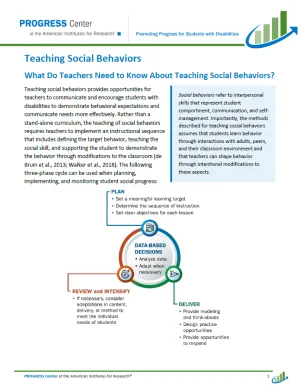
Teaching social behaviors provides opportunities for teachers to communicate and encourage students with disabilities to demonstrate behavioral expectations and communicate needs more effectively. Rather than a stand-alone curriculum, the teaching of social behaviors requires teachers to implement an instructional sequence that includes defining the target behavior, teaching the social skill, and supporting the student to demonstrate the behavior through modifications to the classroom. When teaching social behaviors for students with disabilities, teachers should consider a three-phase cycle of plan, deliver, review and intensify individual, small-group, and whole-group instruction. This brief focuses on planning to teach social behaviors, one of the high-leverage practices for students with disabilities, by identifying and defining a target behavior that poses problems for the student or the classroom environment and considering the conditions that provoke and maintain occurrences. The brief highlights what teachers need to know about the practice, planning to teach social behaviors for students with disabilities, how the practice can be used to support access to the general education classroom, and how to get started planning to teach social behaviors.

Report/Brief
Report/Brief
Report/Brief