With 30 years of experience in public education systems at local, state, and national levels, Elena Rettiger-Lincoln, JD, MSEd, brings a deep understanding of how systems under IDEA are implemented and managed in practice. Her work focuses on helping state and local education agencies strengthen systems, align legal requirements with day-to-day decision-making, and improve outcomes for students with disabilities.
We sat down with Lincoln ahead of her summer webinar series, Hot Topics, Cool Heads, to learn more about building systems to support students with disabilities and how her legal background has influenced the way she helps others connect policy, practice, and student outcomes.
Q: Your work spans leadership, legal practice, and technical assistance. How does that combination shape the way you approach IDEA implementation?
Lincoln: My past experience in those roles encourages me to focus on leveraging regulations for practical results, procedures, support, and guidance so that we can improve student outcomes. Just knowing the law doesn't help as much as knowing what successful implementation looks like in practice. I also really try to focus on viewing the legal requirements positively and not thinking of special education law as red tape. Being able to describe and articulate the requirements in a way that is meaningful to the local teachers, staff, and building principals was the best part of the job.
Q: What do you see as the most common disconnect between legal requirements and what happens in practice in schools?
Lincoln: Many people look for legal guidance that feels black and white, but educational decision-making is rarely that simple. Laws and regulations provide a framework, yet their implementation must be considered within the context of individual students and real-world situations. As a result, educators often navigate gray areas where legal requirements intersect with student needs, family perspectives, and school resources. One of the greatest challenges is feeling confident about what the law requires while thoughtfully managing the many factors that influence day-to-day decisions.
Q: For those trying to sort through those gray areas, where would you suggest they start?
Lincoln: One of the best ways to approach special education procedures is to focus on the "why" behind them. Forms and documentation requirements are not just compliance tasks. They are designed to help teams communicate clearly about decisions, the data used to make those decisions, and any other important factors that were considered. At their core, these questions encourage meaningful conversations about what is best for the student. Understanding that purpose can make the procedures feel less like a checklist and more like a tool for supporting thoughtful, student-centered decision-making.
Looking Ahead: Hot Topics, Cools Heads
In her upcoming webinar series, Lincoln will explore real-world scenarios and legal trends to build participant’s ability to identify risk early, use system data to inform action, avoid costly disputes, and strengthen the systems that support student progress and free appropriate public education.
Q: Why is this series especially timely for state and local education leaders?
Lincoln: Finding time during the school year to pause and think proactively can be difficult. That's why a summer series can be so valuable. It gives educators the chance to dig deeper into topics they encounter every day, reflect on current practices, and consider strategies for addressing common challenges before they arise. Starting the year with that foundation can make a real difference.
Q: What do you hope participants take away from these sessions?
Lincoln: I hope participants gain confidence in understanding what the law requires, so they can focus their energy on what matters most: using data and informed decision-making to support students. I also want them to leave with practical tips and strategies they can use right away to apply those requirements in ways that make sense for their unique situations and school communities.
Q: How will these sessions help leaders move from reacting to issues to preventing them?
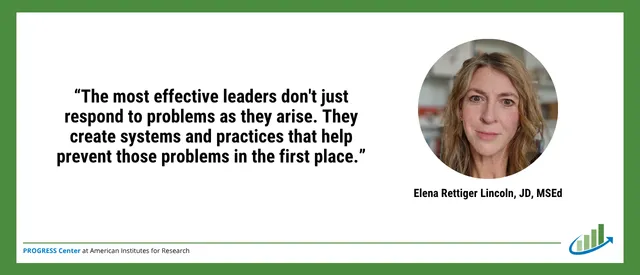
Lincoln: The most effective leaders don't just respond to problems as they arise. They create systems and practices that help prevent those problems in the first place. In this series, we'll explore practical tools and strategies that leaders and coaches can use to build proactive processes, identify concerns early, and create conditions that support positive outcomes for students and staff.
Continue the Conversation with Lincoln This Summer
Interested in learning more? Join Lincoln in our upcoming webinar series, where she'll expand on hot topics such child find, individual education program (IEP) implementation, and discipline decisions, and share practical strategies educators and leaders can use to strengthen systems, support students, and stay ahead of common challenges.
Register for all three sessions in the Hot Topics, Cool Heads Summer Webinar Series!
Each session will share how the PROGRESS Center at the American Institutes for Research® (AIR®) can support leaders beyond the series with tools, resources, and technical assistance for sustained improvement.
AIR does not provide legal advice and cannot respond as an attorney to due process complaints or otherwise provide legal advice related to any formal or informal complaint or set of facts. All services and supports provided by AIR are provided as general information purposes only and as technical assistance in the understanding and implementation of state and federal special education requirements to achieve compliant systems and improved student outcomes.