
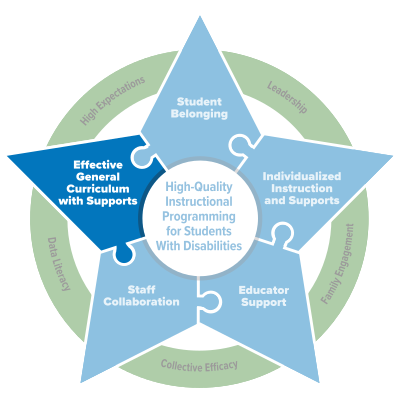
- Building a Successful System
- Student Belonging
- Effective General Curriculum with Supports
- Individualized Instruction and Supports
- Educator Support
- Staff Collaboration
What is it?
Throughout IDEA, Sec. 300.320 (a) there is an emphasis on developing IEPs that support students with disabilities to access and make progress in the general curriculum. Successful students with disabilities have access to general academic, social, emotional, and behavioral evidence-based instruction and curriculum that are delivered using high-leverage practices and supported by services outlined in the IEP. For example, the IEP provides students with supplementary aids and services (e.g., accommodations, assistive technology) that are provided in regular education classes, other education-related settings, and in extracurricular and nonacademic settings to promote access within the general education curriculum.
Research on high-leverage practices indicates some evidence-based practices (EBPs) are particularly effective for students with disabilities (Nelson et al., 2022). These practices include planning instruction and interventions with increased opportunities for students to respond and receive feedback (Common et al., 2020; MacSuga-Gage & Simonsen, 2015), teaching cognitive and metacognitive strategies to address challenges with executive functioning that are common for many students with disabilities (Hosenbocus & Chahal, 2012), and utilizing instructional technologies to support students access and progress in the curriculum (Fernández-López et al., 2013; Hasselbring & Glaser, 2000).
What do teachers and leaders need to know?
To support students with disabilities’ progress in the general education curriculum, schools may use systematic frameworks and schoolwide approaches to identify and address student needs across a continuum of evidence-based supports driven by data (e.g., MTSS, PBIS). Dr. Bryan Cook shared in the IRIS Module, Evidence-Based Practices (Part 1): Identifying and Selecting a Practice or Program, “I think it’s our professional duty as educators to use what is most likely to bring about improved student outcomes. And if you believe, as I do and most educators do, that multiple high-quality experimental research studies are the best way, the most reliable way, to determine whether something works then evidence-based practices just give you the best bet that a practice will work.” Using these evidence-based methods, strategies, and interventions with robust evidence of their impact as a starting point for instructional delivery is critical for effective instructional programming for all students including those with disabilities. When implementing effective instruction and supports for students with disabilities within individual, small-group, or whole-class instruction, educators and leaders should consider following this three-phase cycle:
- Planning instruction by setting meaningful learning targets that attend to unique student needs, determining the sequence of instruction, and setting clear objectives for each lesson.
- Delivering instruction using explicit systematic instruction with multiple opportunities for students to respond and receive feedback.
- Reviewing and intensifying instruction and supports to determine if the instruction is meeting the needs of the student(s) or if an adaptation is needed to the content, methodology, or delivery of instruction.
At the center of this cycle are data-based decisions that are woven into each step of the process of planning, delivering, and intensifying instruction. This instructional cycle can be enhanced by intentional staff collaboration throughout the design, delivery, and review of instruction.
Where can you learn more?


Report/Brief

Online Module
