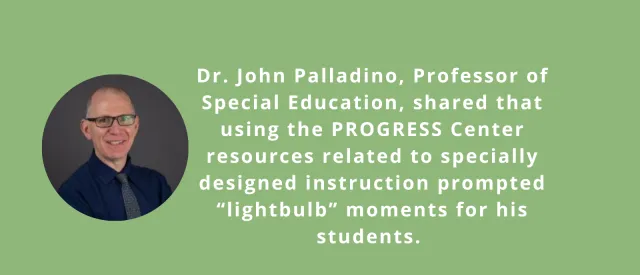
Dr. John Palladino, Professor of Special Education at Eastern Michigan University and PROGRESS Center Educator in Residence, used to be apprehensive about teaching methods courses that focused on educational programming for students with emotional and behavioral disabilities. It was hard to find good instructional resources that addressed both academic and behavioral interventions for this population, and, as a result, the preservice educators in the course—including special education teachers, general education teachers, and paraprofessionals—struggled to conceptualize their roles in developing and implementing instructional-behavioral programming for students with individualized education programs (IEPs).
This all changed when he discovered the PROGRESS Center’s resources and began embedding them into the design and delivery of his course content and learning activities. He appreciated how the PROGRESS Center website linked to vetted resources from external partners and national centers related to relevant topics such as explicit instruction, intensive intervention, universal design, and positive behavioral intervention and supports, all of which furthered his students’ mastery of how to implement academic and behavioral interventions in tandem.
Dr. Palladino shared that embedding the PROGRESS Center resources related to specially designed instruction prompted “lightbulb” moments for his students.
“We train future teachers in all of the ‘pieces’ of special education like the PLAAFP [present levels of academic and functional performance] statement, goals, related services, etc., but what the PROGRESS Center materials help with—and what I used them for in my university coursework—is moving from IEP concepts to actual, boots-on-the-ground SDI [specially designed instruction] and behavioral interventions.”
Even though students in his course had different prior knowledge and experiences, the PROGRESS Center IEP-facilitated activities helped model where students’ instructional needs and services would be documented in the IEP and provided opportunities for gaining a deeper understanding of the IEP as the driving force behind instruction and interventions.
For example, he facilitated the PROGRESS Center’s Getting to Know Your IEP activity within the course using sample IEPs to allow preservice educators to analyze and develop a deeper understanding of the IEP’s required components and the connections between them.
“What's so nice about this is it’s not insulting to the teacher or the school that put together the IEP, but it is a very professional way for preservice teachers to critique and note things that are both strengths and possible shortcomings in an IEP, and how great is it for the document to be the driver of that conversation.”
Dr. Palladino emphasized the accessibility of the PROGRESS Center resources as another strength for using them in his course design and delivery.
“I have a lot of first-generation college students. All of them are on some form of financial scholarship. It’s paramount for me to mitigate their textbook expenses. Although e-books somewhat provide an alternative option, PROGRESS Center resources are optimal free and accessible materials that align with course standards and objectives. Students appreciate the ease of access and practitioner-friendly tone.”
Dr. Palladino feels that the PROGRESS Center website and its resources are valuable tools for supporting preservice educators during their education as well as once they become licensed special educators.
“My hope is, as they get out to the field, they realize, ‘Oh, there’s a national website that has all of what I have been taught and now need to implement on behalf of my caseload students, and then some, and I know how to readily access it all.'”
John Palladino is Professor of Special Education at Eastern Michigan University who specializes in ethical leadership for special education administration, as well as special education programming for secondary students’ transition planning and youth with emotional-behavior disorders. His prior professional experiences include classroom teaching and general and special education school administration. He is also a former foster and adoptive parent of youth with emotional-behavior disorders.