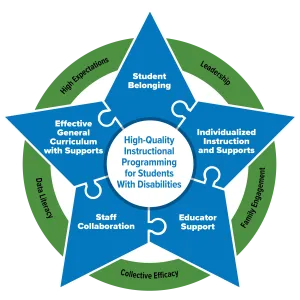
Prepping for PROGRESS 2025! Building a Successful System to Promote Progress for Students with Disabilities focuses on sharing information, resources, and lessons learned to help you develop a system that provides high-quality instructional programming for students with disabilities. This 2-day, free virtual event took place August 12-13, 2025. It is for general and special educators, local leaders, professional development providers, faculty, and other partners who support students with disabilities. Materials and session recordings are provided below.
- Day 1: Welcome & Keynote
The opening session will include a welcome, an overview of the event, and presentation featuring PROGRESS Center Director, Dr. Tessie Bailey and Knowledge Development Lead, Dr. Kaitlin Anderson focused on findings from a recent beating the odds analysis of schools where students with disabilities are outperforming expectations in reading and mathematics. They will be joined by leaders from Powell Middle School in Wyoming—who will share what has helped them to ensure students with disabilities are successful.
Session Materials
 PowerPoint Slides
 Transcript
Day 1: Welcome and Keynote Related Tools & Resources
- Strand 1: Building Blocks of Progress: The Role of the IEP
What is an individualized education program (IEP) and what is its role in the development and implementation of high-quality instructional programming for students with disabilities? This session is intended for educators and leaders who are new to special education or looking for a review of basic information about the IEP. During the session, presenters will describe the role of the IEP in providing free appropriate public education, review the seven required sections of an IEP, and discuss how the parts of the IEP work together to address the individual needs of students to allow them to make progress. Participants will have opportunities for discussion, reflection, networking, and questions throughout the session.
Session Materials
PowerPoint Slides Video Transcript
- Strand 2: Building Access and Belonging: Instructional and Behavioral Practices that Support Students with Disabilities in General Education
Creating schools where every student feels valued and successful goes beyond compliance—it’s about designing learning environments that foster belonging and provide meaningful access to instruction in the general education classroom. Participants will explore what it takes to build classrooms that are structured, engaging, and responsive to learner needs by spotlight practical, high-leverage instructional and behavioral practices that ensure students with disabilities are not only present in general education settings but are able to make progress. Participants will have opportunities for discussion, reflection, networking, and questions throughout the session.
Session Materials
PowerPoint Slides Video TranscriptStrand 2: Related Tools & Resources
- Stories from the Classroom: Appreciating High Expectations
- Building a Successful System: Student Belonging
- IEP Tip Sheet: Overview of Statement of Services and Aids
- The What and Why of the Statement of Services and Aids
- Instructional Practice Briefs
- Evidence-Based Instructional Practices Course Collection
- Strand 3: Supporting English Learners with Disabilities: From IEP Development to Supporting Instruction
Because the development and implementation of a student’s individualized education program (IEP) is intended to be a road map for providing access to free appropriate public education, it stands to reason that an English learner (EL) with an identified disability would require an IEP that reflects the critical data, considerations, aids, and services that address the student’s unique needs related to the intersectionality of English language development and disability. This presentation will begin with a discussion of the development of the IEP, with critical features, considerations, and questions that help align ELs’ instructional needs at the intersection of language acquisition and specially designed instruction. The presentation will then continue with an overview and examples of evidence-based ways to support instruction for students with disabilities who are ELs. Participants will have the opportunity to explore resources, ask questions, engage in a reflective discussion about key takeaways, and develop plans to apply their key takeaways to their own contexts.
Session Materials
PowerPoint Slides Video TranscriptStrand 3: Related Tools & Resources
- OSEP Fast Facts: Students with Disabilities Who Are English Learners Served Under IDEA Part B
- Policy Letter: November 15, 2021 to Boals
- IEP Tip Sheet Series English and Spanish
- Stories from the Classroom: Using a Telenovela to Explain the Special Education Process
- What Works Clearinghouse Practice Guides
- Training to Support Collaborative Conversation Between EL Specialists and Classroom Teachers for English Learner Students in New Mexico
- Promoting the Educational Success of Children and Youth Learning English: Promising Futures
- Day 2: Welcome and Keynote: Potential Policies and Practices to Address Special Education Workforce Challenges
The Day 2 opening session will include a welcome and keynote from Drs. Allison Gilmore and Roddy Theobald from the SPARC Center. In this presentation, presenters will share state examples and discuss potential policies and practices for “beating the odds” at addressing special education workforce challenges related to staffing vacancies, distribution of qualified staff, and staff turnover.
Session Materials
PowerPoint Slides TranscriptDay 2: Welcome and Panel Related Tools & Resources
- Concurrent Session: Doing More with Less: Strategic Blending and Braiding of IDEA Funds Amid Fiscal Shifts
This session will explore practical approaches to blending and braiding IDEA funds to sustain essential services, support student outcomes, and maintain compliance. Attendees will gain insight into how districts may use flexibility to meet needs strategically and truly maximize funding streams for effectiveness.
Session Materials
PowerPoint SlidesStrategic Blending and Braiding of IDEA Funds: Related Tools & Resources
- Concurrent Session: From Compliance to Impact: Crafting Meaningful IEP Goals
How do I know which IEP goals to choose? How do you ensure it is meaningful? This session will address common misconceptions about IEP goals and reinforce efficient strategies for crafting goals to ensure that it truly promotes progress for students with disabilities.
Session Materials
PowerPoint Slides TranscriptCrafting Meaningful IEP Goals: Related Tools & Resources
- Concurrent Session: Leveraging Data-Based Individualization to Design and Deliver Specially Designed Instruction
Delivering high-quality instruction that meets the needs of students with disabilities requires purposeful instructional design and continuous refinement. Did you know there is a process that assists educators in using data to develop and implement specially designed instruction (SDI)? In this session, presenters will model how to use data-based individualization (DBI) to develop and implement SDI for students with disabilities and share resources to support understanding and implementation.
Session Materials
PowerPoint Slides Video Transcript
- Concurrent Session: Leveraging MTSS to Support Students with Disabilities
MTSS is a framework that organizes effective instructional practices, data use, and support for students. Within this session, learn how MTSS can support students with disabilities. Dive deep into how MTSS supports and coordinates high-quality Tier 1 instruction, specialized instruction, and student belonging.
Session Materials
PowerPoint Slides TranscriptLeveraging MTSS: Related Tools & Resources
- MTSS Center
- Instructional Practice Briefs
- Instructional Hierarchy
- Assessment of Use of Opportunities to Respond
- Self-Assessment of Classroom Management Practices
- Intensifying Interventions in MTSS: What To Do When Students Don't Respond To Interventions
- Resources to Support Problem Analysis: Measuring Educationally Relevant and Alterable Variables
- MTSS Team Audit Activity
- Building a Successful System: Student Belonging
- Concurrent Session: Unlocking Potential: How Leaders Can Support Strengthening Services for Students with Disabilities
Supporting students with disabilities requires purposeful leadership – leadership that is intentional, collaborative, and grounded in high expectations for every learner. In this session, the Lead IDEA Center will share a new, interactive tool that principals can use to improve classroom teaching practices and enhance service delivery for students with disabilities in their buildings. Utilizing the Principal Navigator: Strengthening Services for Students with Disabilities, attendees will learn strategies for tackling common challenges that prevent students with disabilities from making meaningful progress and reflect on how to apply solutions within their context. Whether you are a principal, or support principals, this session will provide valuable insights to ensure students with disabilities receive the support they need to succeed.
Session Materials
PowerPoint Slides Video TranscriptImproving Academic Success Through Cognitive and Metacognitive Strategy Instruction: Related Tools & Resources
- Closing Session: Building School Systems that Ensure FAPE in the LRE
In this session Drs. Donna Sacco and Tessie Bailey will share considerations for integrating the essential elements of a successful school system to ensure free appropriate public education in the least restrictive environment for students with IEPs. In addition, we will celebrate what participants have learned across the 2 days and remind participants where they can access tools and resources from the PROGRESS Center.
Session Materials
PowerPoint Slides TranscriptClosing Session: Related Tools & Resources

Learning Event
Learning Event
Learning Event